
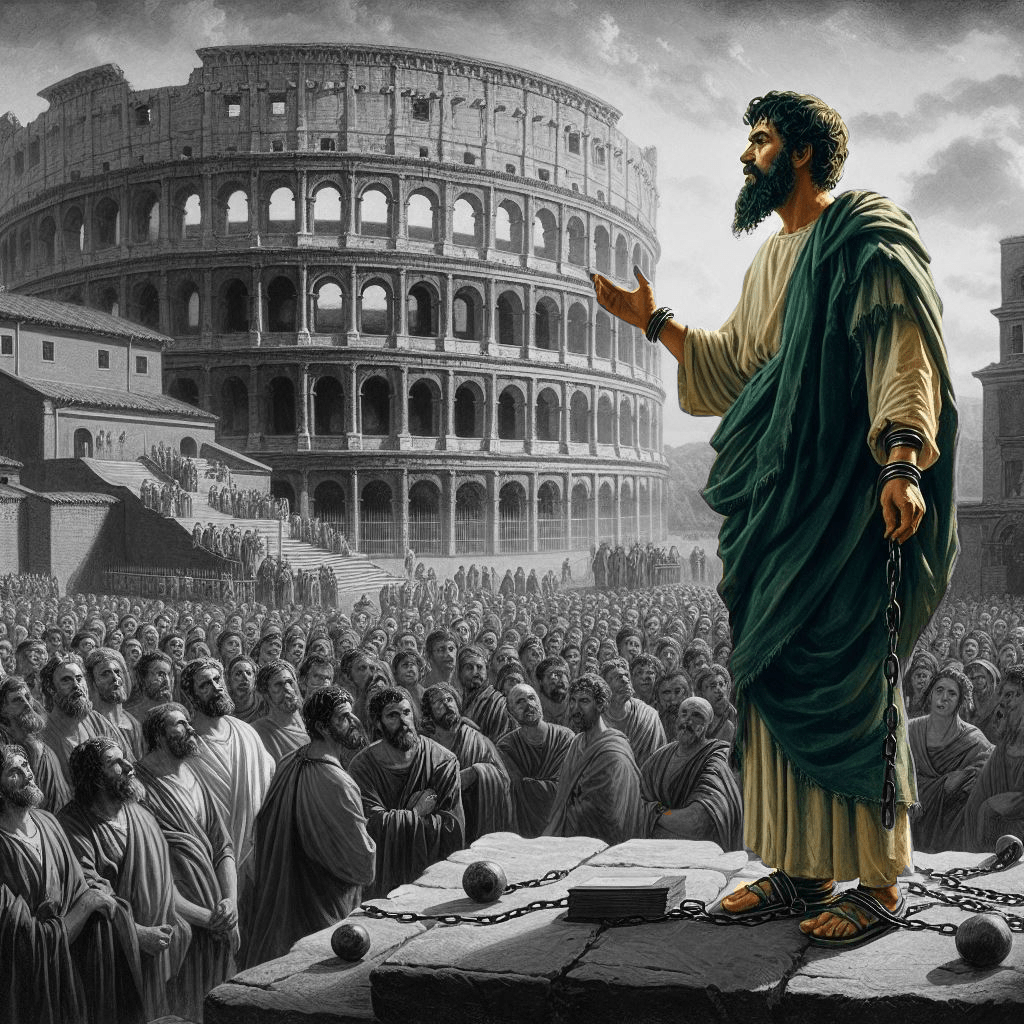

24 While Paul was saying this in his defense, Festus said in a loud voice, “Paul, you are out of your mind! Your great learning is driving you mad.” 25 But Paul said, “I am not out of my mind, most excellent Festus, but I utter words of sober truth. 26 “For the king knows about these matters, and I speak to him also with confidence, since I am persuaded that none of these things escape his notice; for this has not been done in a corner. 27 “King Agrippa, do you believe the Prophets? I know that you do.” 28 Agrippa replied to Paul, “In a short time you will persuade me to become a Christian.” 29 And Paul said, “I would wish to God, that whether in a short or long time, not only you, but also all who hear me this day, might become such as I am, except for these chains.”” (Acts 26:24–29, NASB95)
Have you ever been in a situation where you wondered what God was doing? Where you wondered if God was still there and still in charge? Where you couldn’t fathom why God allowed what He did?
I think I’m safe in saying most if not all of us have been in situations like this. We don’t always know what’s going on in the mind of God. So we can’t always know why things happen the way the do.
What are our responsibilities in those moments when it seems like things aren’t as they seem? What do we do in moments of uncertainty? What should we do when difficult circumstances come?
Let’s look to the life of a faithful servant of God, Paul the Apostle, for some direction in this:
Be content.
Let’s consider for a moment where Paul is in the passage we just looked at. He’s in prison. He’s been in prison for years because of false accusations leveled at him by the religious leaders of the Jews. On top of all this, he has been held against his will the whole time without any hope of release. All of this is evident by Agrippa’s reaction later in the story: “He could have been released.”
Now, Paul could have pouted at this point. He could have complained that he was unjustly accused and held against his will for no reason. He could have said, “I’m done. Gonna sit this one out!”
But he didn’t. Why?
Because had learned that God never loses control. He learned to be content and modeled it here for us. He knew God had him in the exact position He wanted Paul. And he was good with that.
This doesn’t mean Paul didn’t take action. Later in the story he appeals to Caesar so that he can get moving. But while Paul was in that place, he viewed it all through the lens of God’s sovereign will and acted rather than reacting to his circumstances.
That leads us to our next principle.
Be ready to do God’s will.
Because Paul had the right attitude toward his circumstances, he was ready to do whatever God called him to do. He was ready in soul and body to do what was necessary to push forward God’s agenda.
Had he tried to do this without a knowledge of God’s will or with a negative attitude toward God’s will, things might have turned out differently. However, he was ready and willing to share what God had laid on his heart, what was most important to him: the Gospel of Jesus Christ.
Paul knew preaching the truth of the gospel was God’s call on his life, and he was ready and willing to accomplish that godly desire.
This leads us to our last principle.
Be mindful that there are people who need Christ.
Had Paul slunk into the court with a selfish attitude, he would have missed the significance of all this. There were people there who needed Christ. Paul was mindful of these people because he had the right attitude and wanted to fulfill God’s will.
He was ready and willing to share that message with Agrippa. Because of a mindfulness that there were lost people whom he could minister to, Agrippa heard the gospel. Scripture doesn’t tell us how this man ultimately reacted to what Paul said. However, we do know it had some impact on him, otherwise, he would not have asked the question he did.
Although the NASB states his response as “In a short time you will persuade me to become a Christian,” a better rendering of this would be “Do you really think that in such a short time you can convince me to be a Christian?” This gives a more accurate understanding of his response.
In other words, Agrippa was saying, “You are persuasive, Paul, but I don’t think you have enough time to convince me.” Does this mean that Agrippa was feeling the pressure of a well-founded, biblical argument? Did Agrippa turn from his sin and follow Jesus Christ? Did God use Paul to bring salvation to the household of Herod of whom Agrippa was a member?
Only heaven will reveal that secret. One thing we know for certain. When the judgment comes round, Agrippa can’t say he didn’t know. A man in chains made the gospel clear to him, a man who refused to be held back by selfish considerations.
So What?
Contentment isn’t a state of mind. It is a state of reliance on God’s will. If we have the right attitude, are ready to do God’s will and are careful to reject being self-centered while looking to the needs of others, God will use us in incredible ways just as He used Paul, the man in chains, who was willing to bring the message of Christ, even in the most difficult of circumstances.
That’s why Paul could write:
Not that I speak from want, for I have learned to be content in whatever circumstances I am.” (Philippians 4:11, NASB 95)
Who knows? Maybe God will use you to do something great for His kingdom, simply because you were willing, ready and sensitive to the needs of others.
 Journeys of a Former Firebrand
Leave a comment