
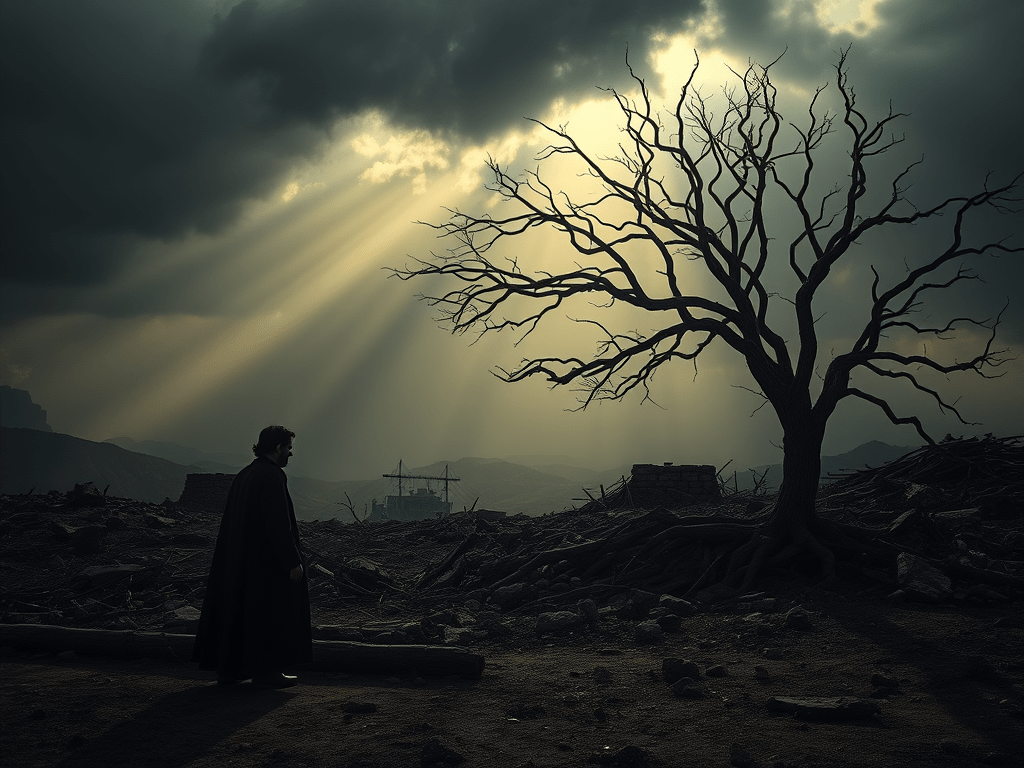

Now on the same occasion there were some present who reported to Him about the Galileans whose blood Pilate had mixed with their sacrifices. And Jesus said to them, “Do you suppose that these Galileans were greater sinners than all other Galileans because they suffered this fate? I tell you, no, but unless you repent, you will all likewise perish. Or do you suppose that those eighteen on whom the tower in Siloam fell and killed them were worse culprits than all the men who live in Jerusalem? I tell you, no, but unless you repent, you will all likewise perish.” And He began telling this parable: “A man had a fig tree which had been planted in his vineyard; and he came looking for fruit on it and did not find any. And he said to the vineyard-keeper, ‘Behold, for three years I have come looking for fruit on this fig tree without finding any. Cut it down! Why does it even use up the ground?’ And he answered and said to him, ‘Let it alone, sir, for this year too, until I dig around it and put in fertilizer; and if it bears fruit next year, fine; but if not, cut it down.’ ” Luke 13:1-9 NASB
I remember a tragedy many years ago that fell on a third world nation. The scenes were devastating. The people were either dead or demoralized. The nation was crushed.
In the middle of all that heartache, I remember one Christian commenting, “That nation is godless. God judged them for their sin. They got what they deserved!”
I have to confess, that comment angered me. That person should have known better. He didn’t apparently.
That’s a sad commentary on a well-established concept in the Christian faith: grace. For such a graceless comment to come from the mouth of a believer should shock us to our core.
You know what’s even more shocking to me? When I catch myself saying things like this. I’m guilty of that “graceless speech” sometimes. I shamefully admit that. I shouldn’t say things like that, but I sometimes do.
In those moments, I turn to Luke 13:1-9 to get a proper perspective of life after tragedy. It’s cathartic, and I thank God He put it there. Let’s study that passage and see what God has to say to us about tragedy.
The Presence of Tragedy
Here’s a news flash. We live in a fallen world. Yes, I know. That isn’t exactly breaking news. Every time we stub a toe, lose our wallet or yell at our spouse or kids, those circumstances remind us we live in a fallen world.
Bad things happen in a fallen world. That’s why tragedies happen every day. Some of them we hear about. Some capture our attention. Some we ignore. All are tragic.
Bad things happened in the ancient world as well. I know, we’re all so far removed from Jesus’ time that we forget they were real people living in real situations. This passage reminds us these were real people with real problems.
Politics played a big role in one of these. Pilate (Yes. That Pilate that sent Jesus to die.) wasn’t a nice man. On top of his foul personality, he hated the Jews. Not a good mixture.
He found ways of tormenting the very people he was supposed to be ruling over. Instead of ruling justly and graciously, he found ways to exterminate the Jews. Years later this would come back to haunt him because he would be executed for doing such a bad job in Israel (but that’s a story for another time).
He traumatized the Jewish nation “whose blood he mixed with their sacrifices.” His method was cowardly and violent. During a feast, Pilate mixed some of his armed soldiers in with the crowd. As the Jews celebrated, the soldiers took out their swords and began hacking at the crowd.
The results were ugly to say the least.
The second story of tragedy isn’t quite as well known. We don’t have details. I’m guessing they didn’t have building departments that made deep inspections of construction work. Because of that, one of their buildings fell down on several people and they died.
We don’t need the details to get the full impact. Those were someone’s father, mother, children, aunts, uncles and cousins who were killed in that tragedy. Many were devastated by the loss. I’m sure many a tear was shed for the lost.
Point? Bad things happened then. Bad things happen now. How do we deal with news of bad things in the world? Do we just say, “They deserved it”? Let’s look at that next.
The Purpose of Tragedy
It’s unwise to try to psychoanalyze God. Too often we do just that. When we assume we know His motives, we commit a grave error that lacks grace, like the man I mentioned earlier.
Here’s the operating principle: we don’t know what God is thinking. Let’s make sure we don’t assume we know what His motives are behind allowing tragedy to happen.
This is the very point Jesus made. A group of people “reported to Him” about what happened. They wanted to pass on the latest gossip and show Jesus how astute they were about why those people died. They wanted to point the finger at others.
Jesus flipped the script on them. “Do you suppose that these Galileans were greater sinners than all other Galileans because they suffered this fate?” He replied. Jesus had set these people up for a startling lesson:
“I tell you, no, but unless you repent, you will all likewise perish. Or do you suppose that those eighteen on whom the tower in Siloam fell and killed them were worse culprits than all the men who live in Jerusalem? I tell you, no, but unless you repent, you will all likewise perish.”
Do you see what Jesus did there? He made it clear why tragedies occur. They don’t necessarily occur as punishment every time they fall on some unsuspecting person. God does always use them as a lesson to us to watch out and be aware of our own failings.
Put simply, tragedies aren’t for everyone else. Tragedies are for us.
The Production of Tragedy
What does tragedy produce? Let’s allow Jesus to answer that for us with a parable:
“A man had a fig tree which had been planted in his vineyard; and he came looking for fruit on it and did not find any. And he said to the vineyard-keeper, ‘Behold, for three years I have come looking for fruit on this fig tree without finding any. Cut it down! Why does it even use up the ground?’ And he answered and said to him, ‘Let it alone, sir, for this year too, until I dig around it and put in fertilizer; and if it bears fruit next year, fine; but if not, cut it down.’ ”
Once again, Jesus hits a home run. The thrust of His statement was to bring us all to one important realization. Tragedies, regardless of who experiences them, are opportunities for us to consider our own sin and repent.
We might say, “But I don’t have sin in my life!” This is the exact attitude the judgmental people of Jesus’ day had. It wasn’t appropriate then. It isn’t now.
We are all sinners. We all have something we need to confess to God (1 John 1). When we deny this, we have to turn our sin-hating proclivities somewhere. Invariably, that’s toward others. The reality is we should turn that energy on ourselves and turn from sin for God’s glory.
In other words, tragedies, even those that happen to others, should produce a better breed of Christian in us.
So What?
The implications are clear:
- We need to stop looking at others. We need to root our contemplations in our own situation when we see others suffer.
- We need to remember that God doesn’t always give us what we deserve. Others may suffer because of their sin. They may suffer for some other reason. We have to remind ourselves we don’t suffer nearly as much as we deserve. This is grace and mercy from God. We should dispense grace as well.
- We also shouldn’t go to the other extreme either. Just because things are going well doesn’t mean God doesn’t care about our bad behavior. If we are sinning, we need to stop. We can’t mistake God’s gracious dealings with us as His favor on everything we do.
- We need to continue bearing “the fruit of repentance” (Matthew 3:8) in our own lives. Daily confession and forgiveness should be a staple of every Christian (1 John 1:9).
- We are no different from anyone else. We should all relate to John Newton’s famous words: “I am a great sinner. He is a great Savior.” We need Jesus. We need His sacrifice because we are just as sinful as everyone else.
That means we all need Jesus to save us from the tragedy of sin. If you haven’t put your faith in Christ alone to save you from the consequences of sin, do so today. You don’t want to be like those people who judged others but ignored their own problems. Put your trust in Jesus today.
Do you know Jesus? If not, find Him here.
Like what you read? Want to help us produce more? Please support us.
Want more blog posts like this? Click here to find more.
Click here to see Bill’s and Ben’s reading lists.
 Journeys of a Former Firebrand
Leave a comment