
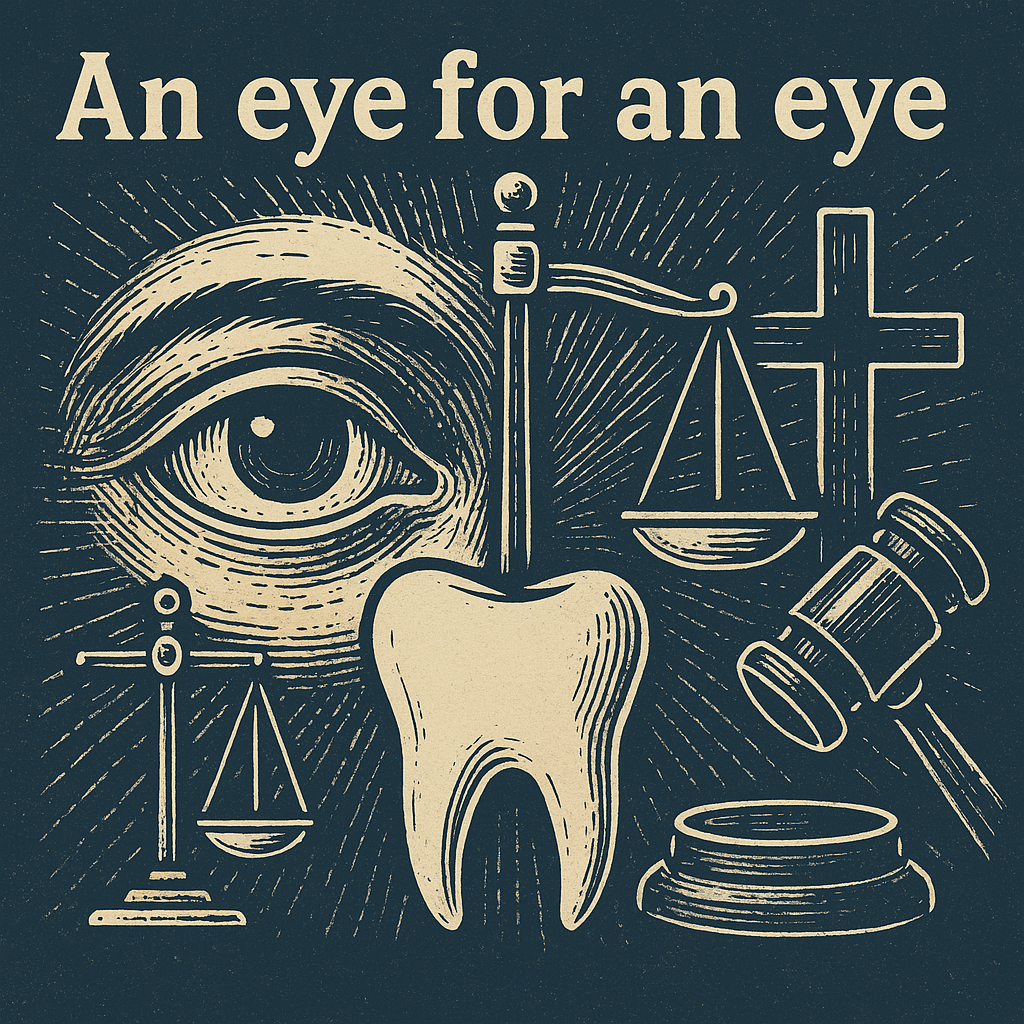

“If a man injures his neighbor, just as he has done, so it shall be done to him: fracture for fracture, eye for eye, tooth for tooth; just as he has injured a man, so it shall be inflicted on him.” (Leviticus 24:19–20, NASB 95)
“Thus you shall not show pity: life for life, eye for eye, tooth for tooth, hand for hand, foot for foot.” (Deuteronomy 19:21, NASB 95)
“You have heard that it was said, ‘An eye for an eye, and a tooth for a tooth.’ But I say to you, do not resist an evil person; but whoever slaps you on your right cheek, turn the other to him also. If anyone wants to sue you and take your shirt, let him have your coat also. Whoever forces you to go one mile, go with him two.” (Matthew 5:38–41, NASB 95)
We’ve all heard the phrase “an eye for an eye and a tooth for a tooth.” Some folks think it sounds a bit harsh—like something straight out of a revenge movie. Others feel it would simply leave the world “blind and toothless.”
Many Christians cling to this idea simply because Jesus Himself seems to criticize it in Matthew 5. But does He criticize it or is there something else going on?
What if I told you this is actually one of the most compassionate and just ideas God put into Israel’s legal code? Sound incredible? It isn’t.
Now, before you raise an eyebrow, hang with me a minute. This is about to get good.
Jesus didn’t reject this principle. He corrected how we live it out. To understand this better, let’s see what God actually meant by this “eye for eye” principle and then put Jesus’ words in their right context.
I. What Did God Mean by eye for Eye?
Israel was a young nation. God had just led them from slavery in Egypt, promising them a better land in Canaan. I’m sure they very much looked forward to that day. But there was a lot that needed to happen before they would become a real nation.
They didn’t have a code of conduct to live by like they did when they were in Egypt. Laws are important if society is to flourish. So God created a code of conduct called the Ten Commandments to guide them.
These laws became the basis for everything else in Israel’s law code. Every law either deals with the people’s relationship with God or each other. This was the two-fold nature of the Ten Commandments: love God and love others.
When God told Israel, “fracture for fracture, eye for eye, tooth for tooth” (Leviticus 24:20), He wasn’t encouraging retaliation. In fact, this principle is based on the “love principle” of the Ten Commandments. God wasn’t telling people they could do anything they wanted to get back at someone. He was limiting the action people could take in situations where vengeance might become a thing.
📏 Think of it like the American legal system’s focus on proportionality. Our Eighth Amendment says, “Excessive bail shall not be required, nor excessive fines imposed, nor cruel and unusual punishments inflicted.” That’s not a coincidence. The foundation is biblical.
The reason why our Founding Fathers wrote that was because they understood the human heart. People want to get back at someone who hurt them. What better way to get back at them than to impose excessive penalties for minor crimes?
Our Founding Fathers knew that wouldn’t work.
Written long before Jesus walked the ancient roads of Galilee, Hammurabi’s Code attempted to enact justice. It failed, sometimes imposing inconsistent penalties on people simply because it fit the politics of the time. But where Hammurabi’s law was harsh and often tilted toward the rich and powerful, God’s law leveled the field.
When God said “eye for eye,” He was saying: “Let the punishment fit the crime.” Don’t go overboard. Don’t cut off someone’s arm because they bruised your ego. And don’t execute someone for stealing your goat. Justice is about balance, not overreaction.
God demanded that the punishment fit the crime. So “eye for eye, tooth for tooth.” Not vengeance. Simple, unadulterated justice.
II. What Was Jesus Saying Then?
So if “eye for an eye” wasn’t bad, what did Jesus mean when He said, “But I say to you, do not resist an evil person…”?
He wasn’t tossing out justice. He’s God’s Son, “very God of very God.” He wrote the law, after all! Jesus wasn’t canceling God’s Word—He was correcting the religious leaders’ twisting of it.
👀 Back in Jesus’ day, the Pharisees had a bad habit of turning God’s laws into personal vendettas. They loved exacting revenge in the name of piety. But Jesus stepped in and said, “Hold up. That isn’t what “eye for eye” means. That’s not justice. That’s vengeance.”
There’s a big difference between the two.
🔍 Justice is what God gives governments to protect and restrain evil. Society can’t survive without it. Vengeance? That’s when we decide to take matters into our own hands because we’ve been wronged. That’s what Jesus was confronting.
And He clearly instructed His followers to avoid that attitude.
✝️ So What?
If someone does something bad to you, show them grace. If someone mistreats you, respond with love. Why? Because that’s exactly how He treated us.
We broke God’s law, and He could’ve justly crushed us. Instead, He went to the cross. Not out of weakness—but out of divine mercy.
We’re not vigilantes with a Bible in one hand and a scorecard in the other. We’re ambassadors of a Kingdom where grace flows freely.
- Governments should seek justice.
- Believers should show mercy.
- And both need to reflect God’s character in doing what He has called them to do.
If justice teaches us what we deserve, grace reminds us of what we’ve been spared.
So the next time someone wrongs you, remember: Jesus had every right to call down angels. Instead, He chose a cross. And because of that, you and I walk free.
Let’s go and live confidently in that grace.
Do you know Jesus? If not, find Him here.
Like what you read? Want to help us produce more? Please support us.
Want more blog posts like this? Click here to find more.
Click here to see Bill’s and Ben’s reading lists.
Want videos instead? Check out our Firebrand Pastors Podcast.
 Journeys of a Former Firebrand
Leave a comment